
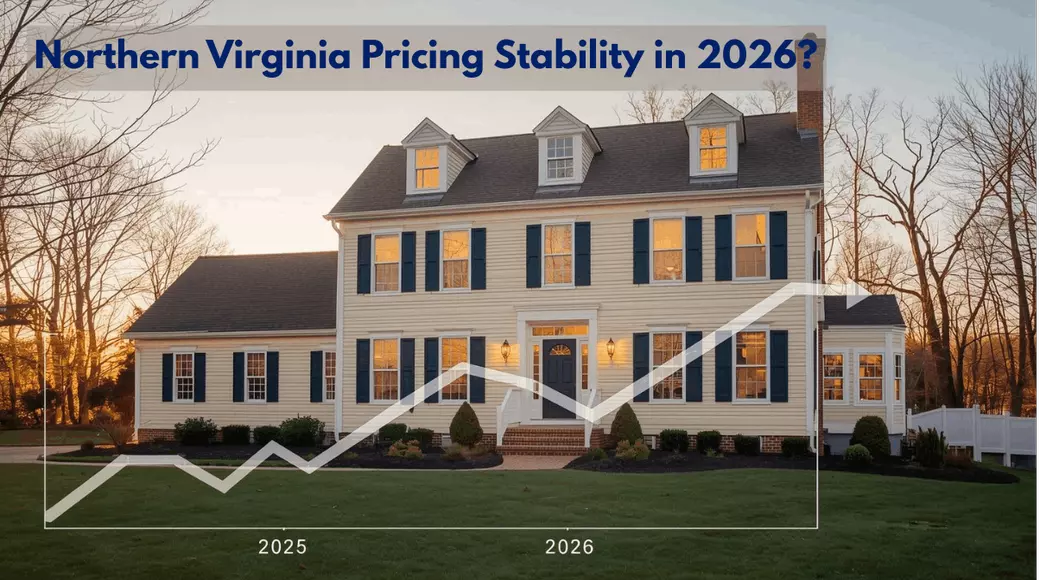
Are Northern Virginia home prices finally stabilizing in 2026, or will they keep climbing?
Short answer:
Yes, prices are stabilizing — but they’re still rising. Across Northern Virginia, 2026 looks less like a sprint and more like a steady walk forward. That distinction matters if you’re a move-up buyer or a long-term homeowner thinking about timing.
The question behind the question
Most people aren’t really asking about prices.
They’re asking about confidence.
Is now still a smart time to move?
Or is patience finally being rewarded?
To answer that honestly, you need two things: what has already happened — and what’s projected next.
What actually happened in 2025 (the reality check)
Before we talk forecasts, it helps to look at 2025.
Using full-year 2025 Bright MLS data, average sold prices increased year over year in every major Northern Virginia counties
-
Alexandria City: up 5.33%, rising from $777,409 to $818,871
-
Arlington County: up 3.29%, increasing from $899,403 to $928,998
-
Fairfax County: up 2.97%, reaching $883,520
-
Prince William County: up 4.67%, climbing to $642,778
Different counties. Different price points.
Same takeaway: prices didn’t stall — they normalized.
This is what a market looks like when it cools without cracking.
Now layer in the 2026 outlook
What’s coming next matters just as much as what already happened.
According to the joint 2026 regional forecast from the Northern Virginia Association of Realtors and the George Mason University Center for Regional Analysis, Northern Virginia home prices are expected to rise at a moderate, sustainable pace this year.
That looks roughly like this:
-
Fairfax County: ~1.9% projected price growth
-
Arlington County: ~3.8% projected growth
-
Alexandria & Falls Church: modest appreciation, varying by neighborhood
-
Prince William County: steadier gains tied to affordability and demand
No surge. No slide.
Just forward motion.
And for many buyers and homeowners, that’s actually the most workable version of a market.
Why slower appreciation isn’t a bad thing
Stability doesn’t mean inactivity. It means predictability.
Across the region, we’re seeing:
-
Slightly longer days on market
-
Fewer emotional bidding wars
-
Pricing supported by sold homes, not momentum
-
Buyers are thoughtful — but still decisive
Well-priced, well-located homes are still selling.
They’re just not selling frantically.
That distinction matters.
What this means if you’re planning a move in 2026
If you’re planning to sell and buy at the same time, this kind of market can actually work in your favor.
-
You’re selling into strength. Prices are still rising — just at a more reasonable pace — which helps protect the equity you’ve built.
-
You’re buying with more clarity. Homes aren’t (necessarily) disappearing overnight, giving you time to evaluate options instead of rushing decisions.
-
You can model the gap more confidently. When appreciation slows, the spread between what you sell for and what you buy becomes more predictable.
Waiting can feel prudent. But if prices continue to inch upward, the home you want doesn’t get cheaper — it simply shifts out of reach. In a stabilizing market, timing becomes less about guessing and more about planning.
What this means if you’re a Long-term Homeowner
If you’ve owned your home for years, this market is quietly on your side.
-
You’ve already captured meaningful appreciation. You’re not trying to time the peak — you’re operating from a position of strength.
-
You’re meeting a more grounded buyer pool. Today’s buyers are informed, realistic, and still motivated — not emotional or reckless.
-
You have flexibility. Whether you’re downsizing, relocating, or simply exploring options, you can move forward without the pressure that defined recent years.
This kind of market favors intention over urgency. You don’t need drama to make a smart move — just good information and a clear plan.
County nuance still matters (a lot)
Northern Virginia doesn’t move as one.
-
Arlington continues to reward location, walkability, and schools
-
Alexandria values character and limited supply
-
Fairfax shows broad stability with neighborhood-by-neighborhood nuance
-
Prince William remains affordability-driven with strong relative growth
Same region. Different math.
Frequently Asked Questions I’m hearing daily
Should you wait until rates drop more before moving?
Rates matter — but they’re only one lever. Price trends, inventory, and your equity position matter just as much.
Are we heading toward a buyer’s market?
More balanced, yes. Buyer-friendly across the board, no. Well-priced homes still hold leverage.
Could prices dip later in 2026?
Seasonal softening is normal. Structural declines are not currently supported by local data.
The bottom line
Northern Virginia isn’t overheating.
And it isn’t retreating.
2026 is shaping up as a measured, stable market — one that rewards thoughtful moves instead of dramatic ones.
If you’re considering a change this year or next, the smartest first step isn’t guessing what the market might do.
It’s understanding how your home, equity, and goals fit into what it’s already doing.
No pressure. No rush. Just clarity.
Tanya M. Blosser
Top-Producing Real Estate Agent
Northern Virginia
If you want to talk through what these trends mean for your specific home or next move, I’m always happy to be a sounding board. Open door. Thoughtful conversation.
Recent Posts